

In 1996, a lifelong dream came true when I bought a house on the lake. It was early July, and after hours of unpacking boxes, all I wanted was to jump in the lake and cool off. I grabbed the leashes for my three Shelties and we headed for the dock. It was 99° outside and all I could think about was diving into the cool blue water.
At the time I had three Shetland Sheep Dogs. A smart and fun-loving breed, but they are herd dogs. My thought was herd dogs go where their herd is, regardless if it was water or land. That opinion proved to be partially right.
I had two rescues, Annie and Reese, who never let me out of their sight, and a puppy named Tully, whom I had introduced to the lake the precvious. I wondered whether Annie and Reese would ever learn to love the water too.
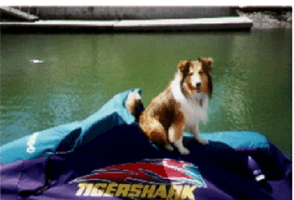
It was too hot to think about it for long and I dove in and swam out about 40 feet, then rolled over to check on my pups. I was thrilled to see Tully paddling toward me like a natural. That thrill was short-lived. Annie always had to be near me or at least be able to see where I was. She jumped onto the seat of my wave runner, and as she tried to keep her balance, the dock line tightened and pitched her straight into the lake. It would have been funny if she hadn’t been panicking. I swam toward her as fast as I could, with Tully right behind me. “It’s okay, Annie! Good job!” I called out, trying to sound calm. The moment I had her in my arms, the unexpected happened — Reese who was watching from the dock, in all the excitement, she did exactly what I had been training her to do: she rolled over. Right off the edge and into the water.
Now all of us were in the water, and I had to act fast. Tully paddled around in tight little circles, looking amused but offering no help. With no dock ladder or shoreline nearby, I hauled myself onto the wave runner and scrambled up onto the dock. One by one, I pulled each dog to safety. As soon as they were back on the dock, they shook off the water and began chasing each other around as if nothing had happened. I didn’t share their enthusiasm. I was exhausted and anxious. This is not good, I thought. They have no fear of the water, and this could happen again — and next time, I might not be around to help.
I spent the rest of the day thinking I made a big mistake. The next morning, Tully woke me up barking at the sliding glass door in the bedroom — she could see the lake and clearly wanted to get back to it. After a quick, drama-free swim, we came back inside, and I started calling local marine supply and pet stores. I was looking for some kind of ramp or device people used to help their dogs out of the water when there was no shoreline. To my frustration, no one had ever heard of anything like it. I couldn’t believe a product like that didn’t exist. The next morning, Tully woke me up barking at the sliding glass door in the bedroom — she could see the lake and clearly wanted to get back to it. After a quick, drama-free swim, we came back inside, and I started calling local marine supply and pet stores. I was looking for some kind of ramp or device people used to help their dogs out of the water when there was no shoreline. To my frustration, no one had ever heard of anything like it. I couldn’t believe a product like that didn’t exist.The next morning, Tully woke me up barking at the sliding glass door in the bedroom — she could see the lake and clearly wanted to get back to it. After a quick, drama-free swim, we came back inside, and I started calling local marine supply and pet stores. I was looking for some kind of ramp or device people used to help their dogs out of the water when there was no shoreline. To my frustration, no one had ever heard of anything like it. I couldn’t believe a product like that didn’t exist.
I fired up my computer — on a dial-up connection — and spent hours searching. Every link I hit went nowhere. It was clear: this product simply didn’t exist. I was torn between my love of lake life and the need to keep my dogs safe. Eventually, the answer became obvious. If no one had built it yet, I would have to build it myself.
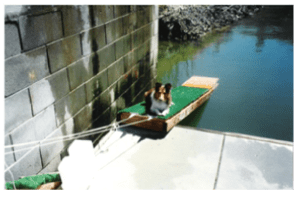
I envisioned a ramp of sorts, but since I didn’t own the dock, my design options were limited — though not my vision. I tried all sorts of configurations and eventually landed on board with life vests tied to it for flotation. It was crude, and tacky, however the dogs didn’t care and it worked. Finally , I could relax and enjoy my days at the lake.
Before long, the neighbors asked if they could bring their dogs to use it too. i could hardly believe how much all of the dogs love using it. I also loved to see boaters on the lake anchored out and watching the circus as the dogs would leap off the ramp, race for a ball, and scrambling back up to do it all over again. I imagine the sight of dogs of all sizes launching off the dock and bumping each other off was quite entertaining for spectators. Even so, I never seriously considered selling doggydocks® commercially — though I did build them for a few neighbors and a couple for local pet stores. It would take several years before I felt convinced there was real demand.
Even for a seasoned entrepreneur, doggydocks® felt personal to me. I loved my dogs and the water, but I couldn’t quite believe I could make a living from something I cared about so deeply. Over time, though, I came to see that other dog owners shared the same concerns, and that I wasn’t alone in wanting to keep dogs safe around water.
A few years after we began selling doggydocks®, a writer from a national boating magazine asked me a simple question: “Why did you develop doggydocks®?” I’d heard the same question several times but this time it triggered something and I was overcome with a memory I had long buried — the dog I had lost more than 20 years earlier, who had drowned in a friend’s swimming pool. The grief had been so heavy that I’d pushed the memory away entirely. In that moment, I understood, perhaps for the first time, why I had poured so much time, energy, and money into creating this product. It was my way of healing — from grief, and from the guilt of knowing my dog had drowned because there was simply no way for her to get out of the water.
Over the years, doggydocks® has helped prevent countless drownings, and that remains the driving force behind everything we do. What surprised me along the way is that the majority of our customers are owners of water-loving dogs who have turned doggydocks® into a favorite toy — something both they and their dogs genuinely enjoy. As it turns out, the dogs didn’t much care that it was supposed to be a serious life-saving device.
Thank you for reading the doggydocks® story. If you have questions, please don’t hesitate to reach out by email or phone. There is nothing I love more than talking with other dog owners.
Theresa Marler
PupGear Pet Products